
Field Note 03 | A Day For 2000 Trees
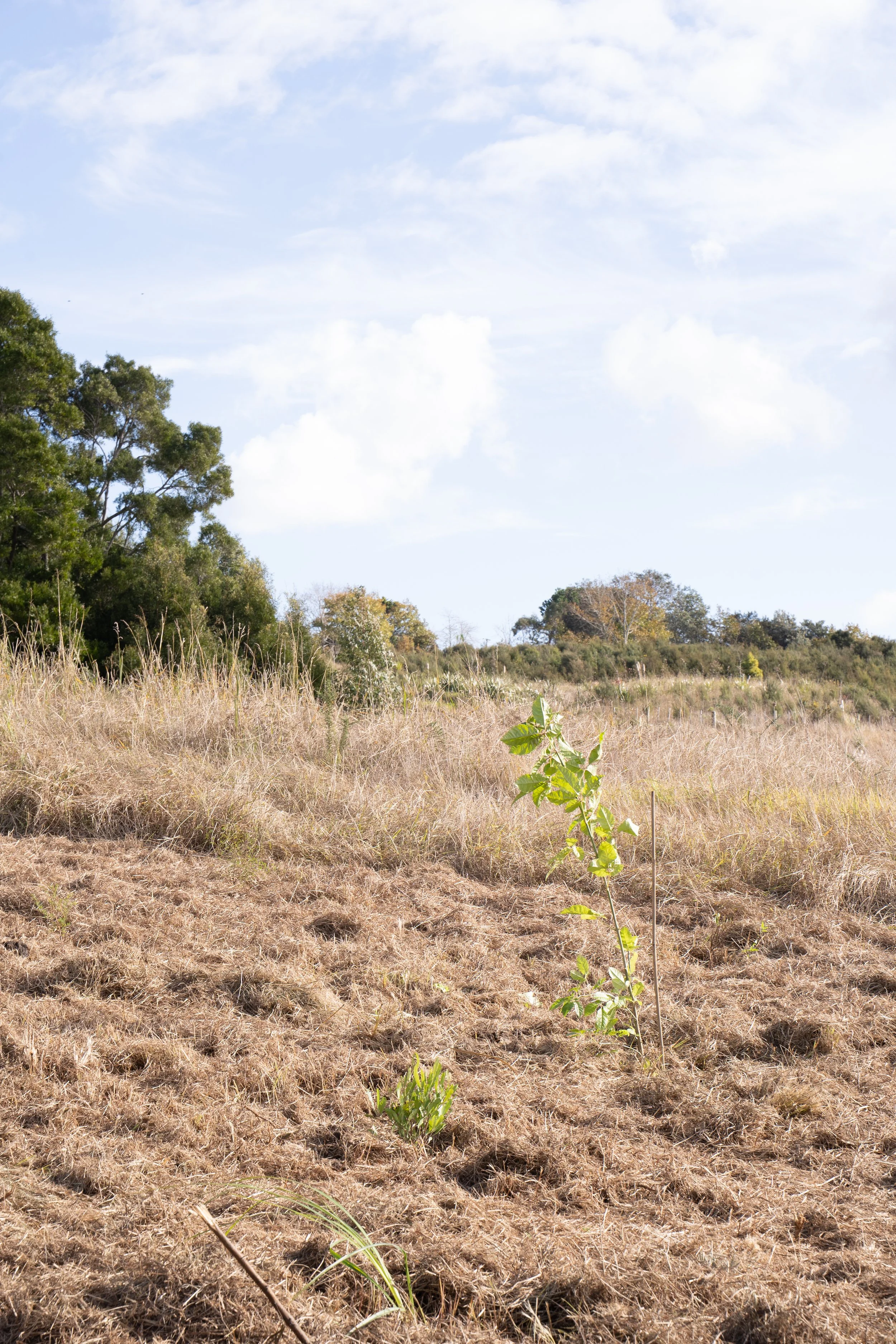
The first thing you notice is how small they are. Not fragile exactly, but decidedly delicate - the mānuka especially - with their tiny little roots, hardly the stuff of forest. And yet mānuka is what goes in first when forming new ngahere. It grows fast and tough, sheltering the slower trees behind it, holding space for what comes next.
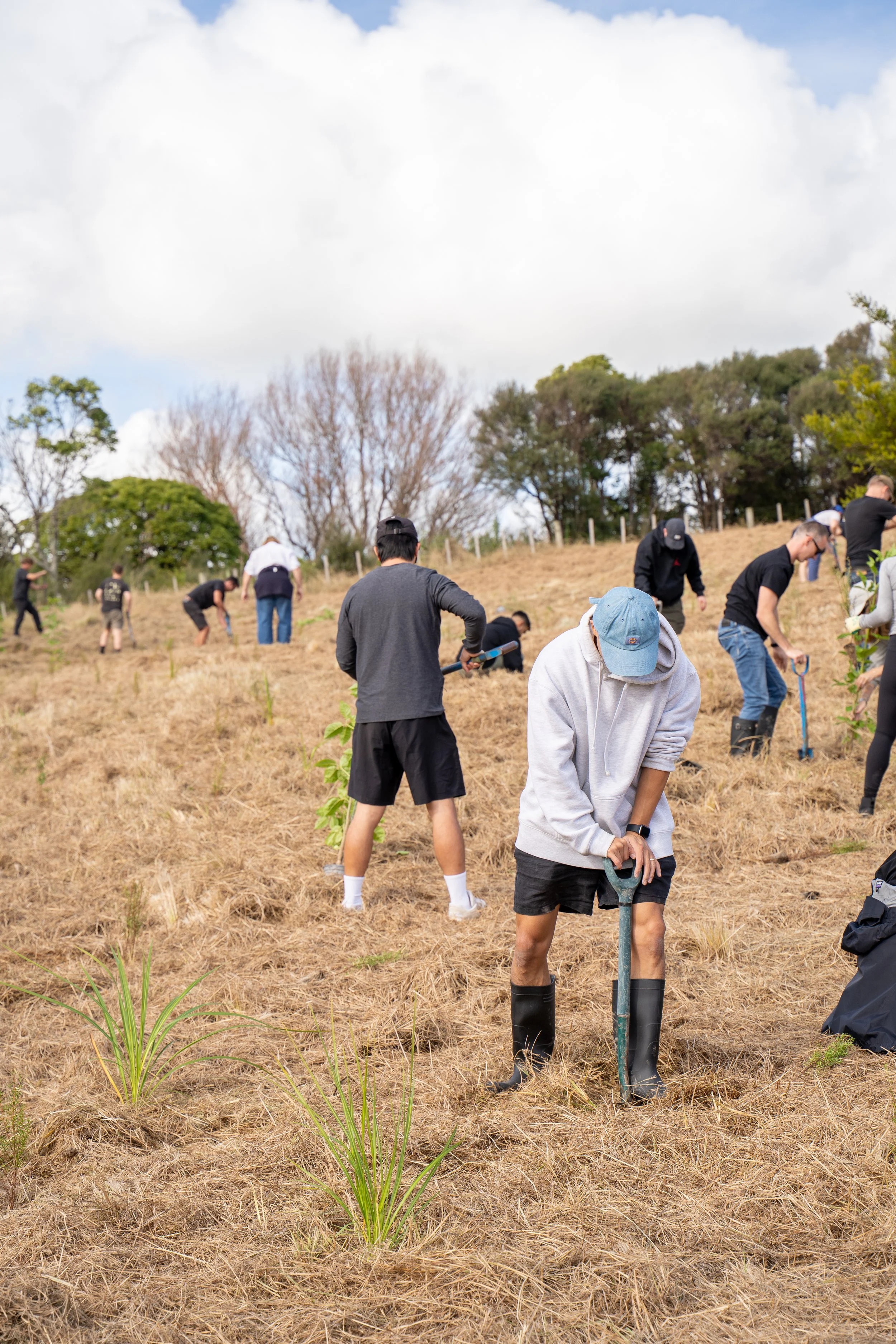
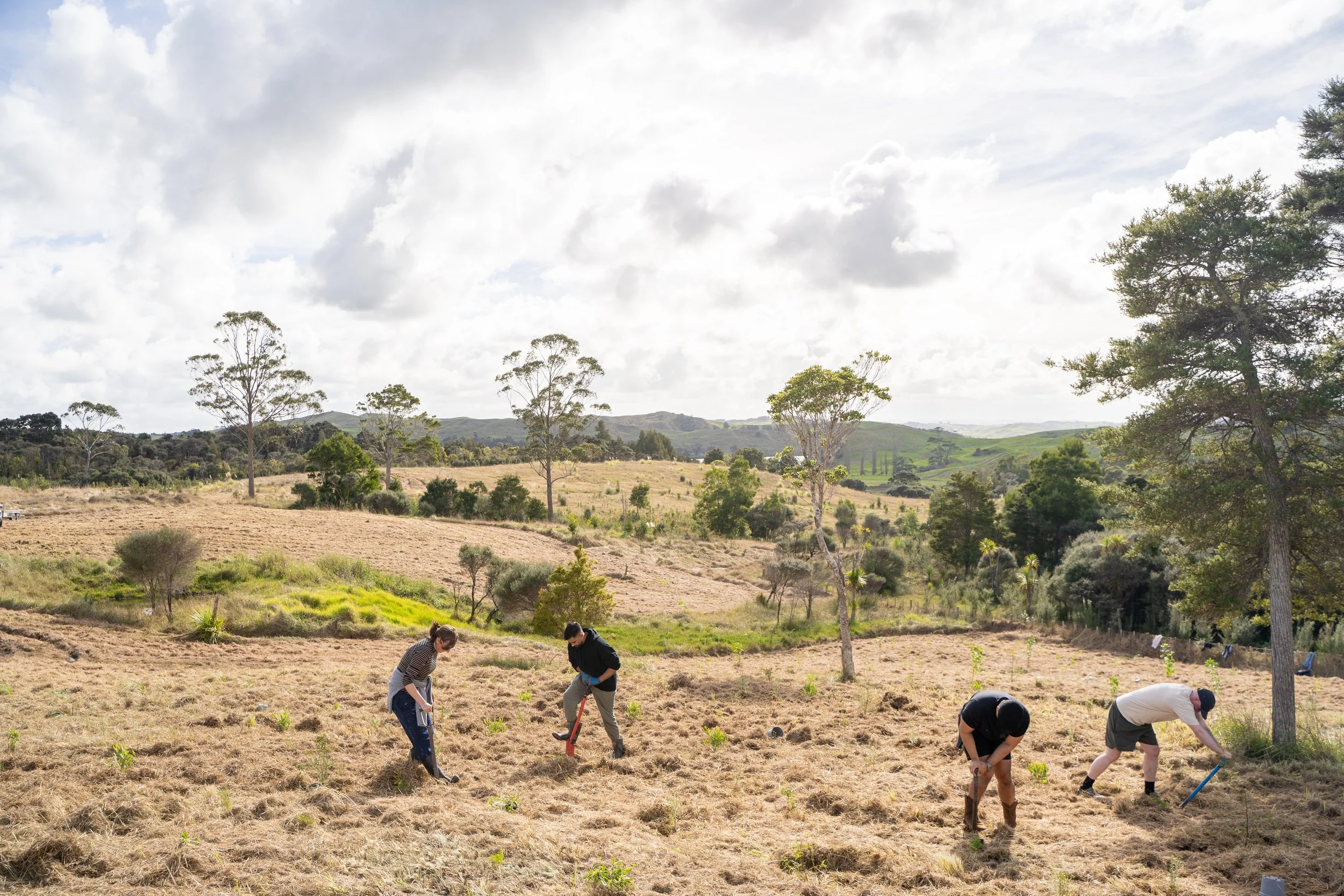
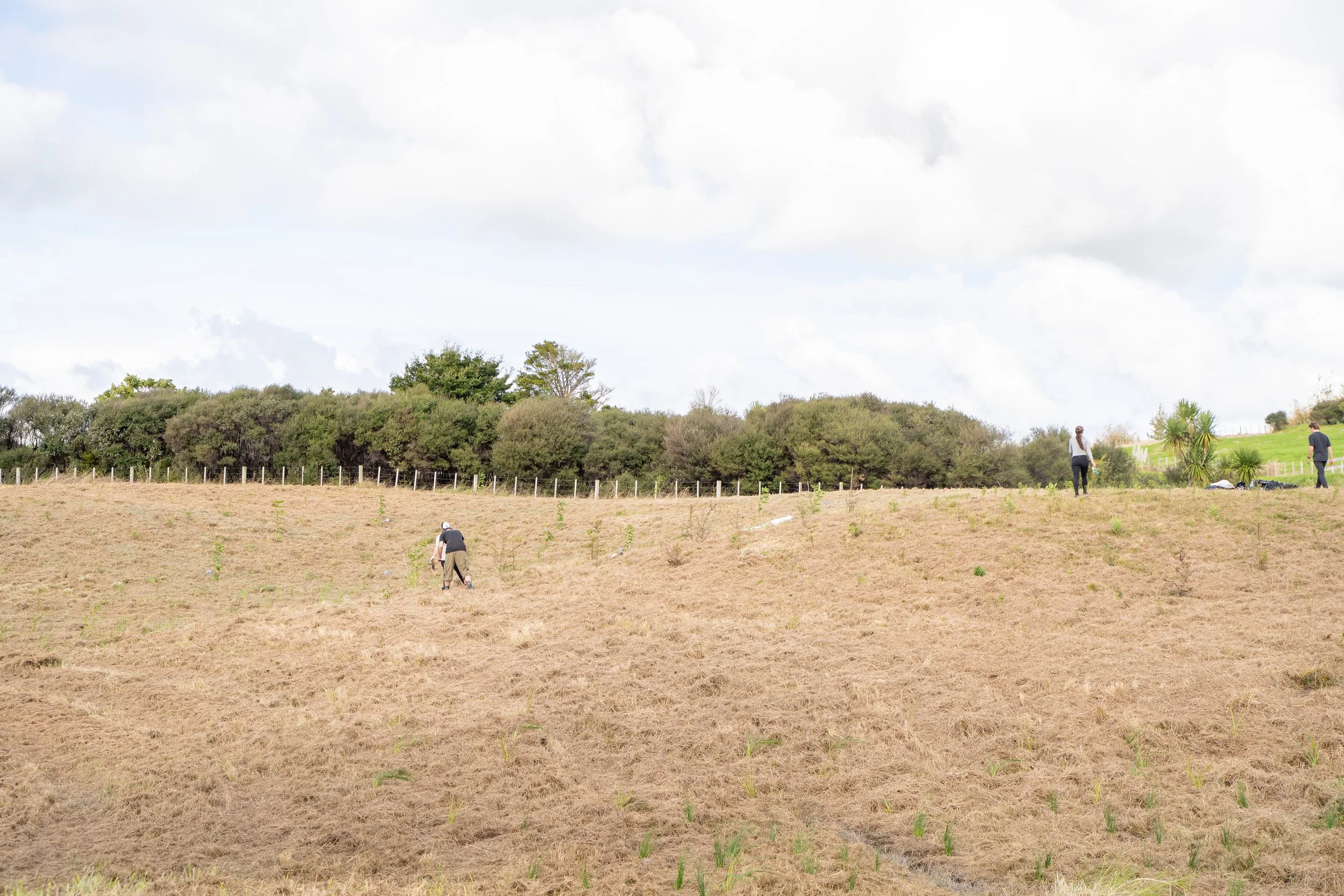
There were forty of us, architects and designers, and we planted two thousand of them, trees of the future, on a slope overlooking the upper reaches of the Kaipara. Mānuka, kōwhai, rimu, kauri. Each one packed into earth briefly opened by our spades; boots and muscles and torque employed to repeat the gesture time and time again. Roots pressed into contact with soil that until recently was farmland - grazed flat, stripped of its richness over generations. You work quickly when there are two thousand to place, but the repetition has its own quality. By midday your hands know the motion: dig, tip, press, firm, move on. Not bad for a group more accustomed to the pavement than the mud.
We worked at different paces, some machinely efficient, others planting and storytelling in unequal measure, but all committed to the cause. There’s something spurring about the sight of hundreds of trees laid out on the hillside, waiting, reliant on your efforts. At the risk of revealing the indoor-ness of our lives, many of us agreed that it felt good – centering, even – to work with the land, outside, in motion. The lunchtime barbeque was a fitting reward for the mahi: appropriately humble, wickedly delicious.
The act of planting is meditative, and as I worked I kept thinking about scale. Not the scale of the planting - though two thousand is a satisfying number - but temporal scale. The kauri especially. They were tiny, maybe half a metre, and a mature kauri is centuries in the making. Whatever we put in the ground that day, we will not see it fully become what it is. It is different from architecture in this way.
In the afternoon, we walked through a forest planted eight years ago on a site not far from Nat’s place, where we had just been. Same plants, same intent, different time. The mānuka was doing its job – a closed canopy sprung up where there had been open paddock. Beneath it there was shade, leaf litter, the sound of birds. The air was cooler, fresher. We walked down to the mangroves at the edge of the water. A pīwakawaka hung around for a while.
Eight years. That's all it took for the land to regain its sense of self.
In the quiet of that young forest, I realised our act of planting was janusian. Sure, it contributed to the equalising of carbon balance-sheets, with contributions measurable in data and calculations. But it also contributed to the resurfacing of wairua, for a land reduced to resource, and for people disconnected from the soil. The forest around us was proof of that. The space we'd made that morning - a paddock staked with small green tufts - would become this, given time and left alone. Maybe this is what the work actually is: less a question of designing for the known finish line, and more a question of faith. Setting the conditions. Getting out of the way. Nature is more than capable of doing the rest.
Northland, New Zealand - May 2026, with Cheshire Architects